Why Trust 1st Choice Leisure Buildings?
Choosing a garden building is an investment, so it's important to buy from a company you can rely on. At 1st Choice Leisure Buildings, we've been helping customers find the right garden sheds, summerhouses, log cabins, garden offices and workshops
since 1979 when
Robin Antill opened the doors. As a
family-run business, we believe in offering honest advice rather than a hard sell. We take the time to understand what you need and help you choose a building that suits your garden, your budget and the way you plan to use it.
Our approach is reflected in our
4.9 Trustpilot rating, where customers regularly mention our friendly, helpful service. We only work with manufacturers we trust, selecting buildings that offer good quality, durability and value for money. Most are made from
FSC®-certified timber and built to cope with the British weather. If you'd rather see a building before you buy, you're welcome to visit one of the
UK's largest garden building display sites.
1st Choice – Known For Quality – Loved For Design - Since 1979
Being able to compare different models and talk things through with our experienced team helps many customers make the right decision.
Since 1979, we've supplied over 50,000 buildings across the UK, building our reputation on quality products, straightforward advice and customer service you can depend on. We are always available to meet your needs or requirements so
contact us NOW if you would like help or advice.
We live quite far away; is it really worth visiting our show rooms? Absolutely!
We strongly urge anyone looking for a new building – whether it's a new garden shed, summerhouse, workshop, garage, or a full garden room – to
visit and inspect the quality in person before committing to any purchase.
Seeing the craftsmanship, materials and finishes for yourself is the best way to make a confident and informed decision.
Whilst we cannot display everything we offer, we have carefully selected around 80 different buildings that allow us to demonstrate almost every feature, design option, and construction detail in one form or another.
This allows you to compare styles, sizes and specifications, ask any questions you may have, and find the building that best suits your needs.
So, yes, it is absolutely worth visiting.
Click here to see what buildings on display.
If you are unsure then
why not walk through our site virtually using our walk through tour below (or
click here to open in a new full screen window).
Choosing the Right Metal Shed for Your Garden
A good metal shed is primarily about three things: security, low maintenance and dependable outdoor storage. For many customers, particularly those storing valuable equipment, cycles, machinery or bulky garden items, a well-built galvanised steel building offers a practical alternative to a traditional timber building. The important point is that not all steel storage buildings are constructed to the same standard. Steel thickness, door design, locking system, ventilation, anchoring method and the base underneath the building can make a substantial difference to how satisfactory it will be in everyday use.
At 1st Choice Leisure Buildings, we prefer customers to look beyond the headline price. After many years of selling outdoor buildings, we know that the cheapest building is rarely the cheapest if it is awkward to use, inadequately secured or needs replacing sooner than expected. Compare the specification, decide what you intend to store and choose the building that gives you the right combination of access, strength and usable internal space.
Who Is a Metal Shed Best For?
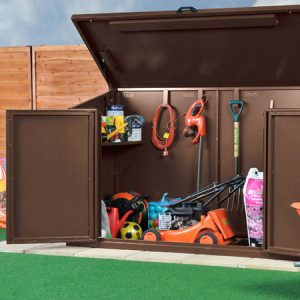
A steel storage building is particularly worth considering when you want a secure, robust structure without the routine treatment normally associated with timber. It can work well for gardening equipment, lawnmowers, outdoor furniture, household storage, sporting equipment and other possessions that need to be kept out of the house or garage.
- Security-conscious owners: heavier-gauge steel, reinforced doors and suitable locking systems can offer a strong deterrent to opportunist theft.
- Low-maintenance buyers: galvanised steel does not require regular preservative treatment in the way exposed timber normally does.
- Gardens where space is valuable: slimline and compact designs can make use of areas beside a house, garage or boundary.
- Owners of valuable equipment: selected models provide enhanced security features and can be securely anchored to a suitable base.
- Customers wanting larger storage capacity: longer and wider models provide room for machinery, equipment and workshop-style storage.
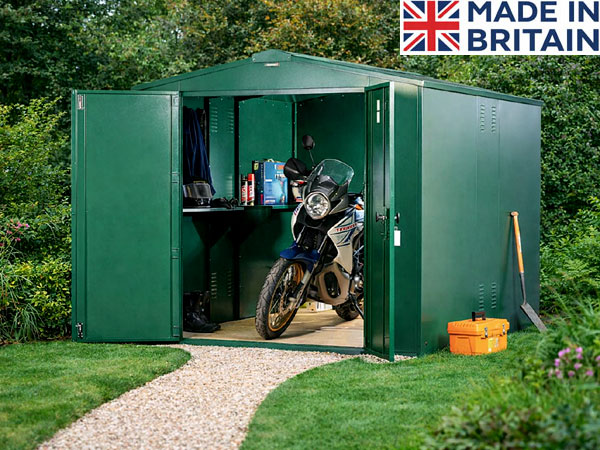
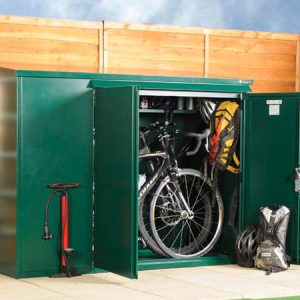
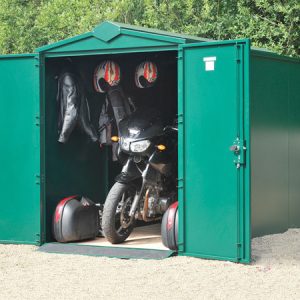
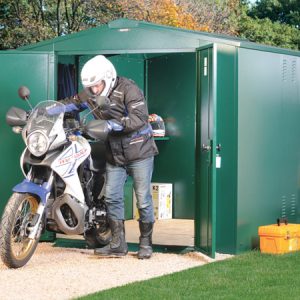
If your main requirement is dedicated cycle storage, see our bike storage options. If you specifically need to accommodate a motorcycle, it is also worth comparing our motorcycle storage buildings. These dedicated categories make it easier to compare buildings designed around those particular uses rather than trying to make a general-purpose store fit the job.
Metal Shed Comparison: What Should You Compare?
The words “steel shed” can describe buildings with very different specifications. Before comparing prices, compare the details below. These are the areas we would look at ourselves before recommending one building over another.
| What to compare |
Why it matters |
What to check before ordering |
| Steel construction |
Heavier material generally contributes to a more substantial structure. |
Check the stated steel specification for the individual model rather than assuming every building is identical. |
| Door security |
The door and its locking points are often more important than the wall panels when valuable contents are stored. |
Look at the lock, hinges, door reinforcement and how the doors engage with the frame. |
| Security certification |
Independent testing can provide useful evidence rather than relying entirely on marketing descriptions. |
If certification is important to you, confirm that the specific model you are buying holds the appropriate certification. |
| Ventilation |
Air movement helps reduce the conditions that encourage condensation. |
Check how the building is ventilated and avoid blocking vents once installed. |
| Base and anchoring |
A strong building is only as dependable as the surface to which it is fixed. |
Confirm the required base dimensions, ensure it is level and establish how the shed will be anchored. |
| Floor arrangement |
Different designs use different floor or floor-base arrangements. |
Check precisely what is included with your chosen building and what base must be prepared beforehand. |
| Door opening |
A large building is frustrating if the equipment cannot easily pass through the doors. |
Measure your mower, machinery or other bulky equipment as well as the available garden space. |
| Assembly |
Correct assembly affects alignment, doors, anchoring and weather performance. |
Check whether the model is self-assembly, has an optional installation service or includes assembly. |
Heavy-Gauge Galvanised Steel: Why the Specification Matters
Galvanising protects steel against corrosion by adding a protective zinc coating. For an outside building exposed to British weather, this is an important part of its construction. However, “galvanised” by itself does not tell you everything about a building. Panel thickness, folds in the steel, reinforcement, fixings, doors and overall design all contribute to its strength.
Our current GardenVault range includes different steel specifications according to the model, so compare the individual product details rather than selecting purely by external dimensions. A compact storage unit and a substantially larger security building may be designed for quite different jobs.
Are thicker steel panels always better?
Steel thickness is an important indicator, but it should not be viewed in isolation. A well-designed structure combines the steel panels with suitable framing, door reinforcement, secure fixings and anchoring. When security is your priority, consider the complete construction rather than one measurement.
Security: Look at the Whole Building, Not Just the Lock
Customers often ask us which lock is fitted, but effective storage security is a combination of several features. The doors, hinges, framing, fixings and the way the building is attached to its base all matter. A substantial lock is of limited value if the surrounding structure or foundation is weak.
Selected GardenVault models incorporate enhanced locking and security features, while several models have been independently tested or certified to recognised security standards. If you have a specific insurance or security requirement, check the certification of the exact model before ordering; do not assume that certification applying to one building automatically applies to the entire range.
For particularly valuable contents, also consider how the items themselves will be secured inside the building. Good physical security works in layers: the garden boundary, the shed, the doors and locks, anchoring and internal security can all play a part.
The Base Is One of the Most Important Parts of Your Purchase
One of the most common problems we see with outdoor buildings begins underneath them. A metal storage building needs a firm, flat and level base. Putting a substantial steel building directly onto lawn or soft soil can allow it to move or sink, which may affect door alignment and the overall structure.
Recommended base dimensions are provided for individual products. Prepare the correct base before installation and make certain you understand whether your chosen model bolts directly to the base or uses a separate floor-base arrangement. If you need help preparing the site, see our garden building and base services.
Should the base be exactly level?
Yes. Level really does matter. Even a strong steel structure can develop frustrating door problems if it is assembled on a surface that slopes, twists or subsequently settles. Spending money on the building while trying to save a small amount on inadequate groundwork is usually a false economy.
Condensation in Metal Sheds: What Buyers Need to Know
Condensation is possible in virtually any enclosed outdoor building when warm, moisture-laden air meets a colder surface. Metal makes the effect particularly noticeable because the internal surface can cool quickly. That does not mean every steel building will suffer badly from condensation, but ventilation and a correctly constructed base are important.
Keep ventilation openings clear, avoid introducing unnecessary moisture and make sure rainwater is directed away from the base rather than allowed to collect around it. Plants and dense vegetation immediately against the building can also restrict airflow and retain moisture. If you are storing items that are particularly vulnerable to moisture, allow air to circulate around them rather than packing everything tightly against the walls.
Will ventilation completely eliminate condensation?
No, and we’d be wary of anyone who tells you it will. Good ventilation makes a big difference, but condensation also depends on the weather, the base your building sits on, what you keep inside and how often you’re opening the doors. Get the base right, allow plenty of airflow and use the building sensibly, and you’ll greatly reduce the chances of condensation becoming a problem.
Common Mistakes When Buying a Metal Shed
Most disappointing purchases are caused by choosing on price or external size alone. These are the mistakes we would encourage customers to avoid.
- Buying the smallest size that will hold everything today. Storage requirements have an annoying habit of growing. Allow practical room to move around and remove items without emptying half the building.
- Forgetting the door opening. Measure the widest item that needs to enter the building, not merely the outside dimensions of the shed.
- Ignoring the base until the building arrives. Establish the exact base requirement at the beginning. A poor or unfinished base can delay installation and create problems later.
- Assuming every steel building has the same security. Compare locks, hinges, doors, steel construction, anchoring and any independently verified security rating.
- Assuming “metal” automatically means fire-rated. Steel does not readily ignite, but that is not the same as a building having an official fire-resistance certification. GardenVault sheds should not be described as certified fireproof buildings.
- Blocking ventilation. Filling every available gap or positioning stored items directly over vents can increase moisture problems.
- Not checking access to the installation position. Consider gateways, side passages, steps, walls, overhanging trees and how components will reach the site.
- Comparing only headline prices. Establish what is included: floor arrangements, delivery, installation, security equipment and any options can substantially change the real cost and value.
- Failing to check planning constraints. Many domestic outbuildings can be installed under permitted development, but rules vary with position, height, property type and location. Read our garden building planning permission guide and check with the appropriate authority when necessary.
How Much Storage Space Do You Actually Need?
Measure the objects first and the garden second. Make a quick list of everything you expect to keep inside: mower, garden furniture, tools, pressure washer, wheelbarrow, barbecue, sports equipment, storage boxes and anything else that currently occupies your garage or house. Then consider which items you need to reach regularly.
A building that technically has enough cubic capacity can still be awkward if everything must be moved to reach the mower at the back. Door location, shelving and a clear route through the building matter almost as much as total floor area. Where your garden allows it, a little additional capacity is usually more useful than buying a building that is full from day one.
Metal, Timber or Concrete: Which Storage Building Is Right for You?
| Material |
Main strengths |
Things to consider |
Often suits |
| Galvanised steel |
Low routine maintenance, strong security options, efficient storage and no timber treatment required. |
Requires a sound level base; ventilation and condensation management matter. |
Equipment storage, valuable contents, low-maintenance requirements and security-conscious buyers. |
| Timber |
Traditional appearance, easy to customise internally and a wide choice of designs. |
Quality and treatment vary considerably, and ongoing care may be required depending on construction. |
Customers who place a high value on traditional appearance and customisation. |
| Concrete |
Very substantial construction, excellent longevity and strong fire and security characteristics. |
Permanent installation and more substantial groundwork are normally required. |
Long-term high-security storage where permanence is desirable. |
There is no single material that is automatically best for everybody. Start with the intended use, security requirement, appearance, maintenance expectations and available budget. You can compare the wider range from our shed department or speak to us if you are uncertain which construction method makes most sense for your garden.
Delivery and Professional Installation
Delivery and installation options vary across the GardenVault range, so it’s worth checking the individual product details before you order. Professional installation is available on selected models and is well worth considering for the larger buildings, where getting everything level, square and securely anchored makes all the difference.
Delivery lead times can change during the year and according to the building and destination. Rather than relying on an old delivery estimate quoted in permanent page copy, check our current delivery information before ordering if you are working towards a particular date.
Why Buy Your Metal Shed From an Experienced Garden Building Supplier?
A storage building is difficult to judge from a small photograph. Customers should be able to ask awkward questions about construction, security, bases and installation before spending their money. Our role is not simply to sell the biggest or most expensive option; it is to help you choose a building appropriate for what you intend to put in it.
1st Choice Leisure Buildings has been supplying garden buildings since 1979. Customers can also visit our Surrey display site near Woking, Ripley and Guildford to examine garden buildings and construction details for themselves. Although it is impossible to display every size and variation, seeing full-size buildings is often the best way to appreciate differences in doors, materials, internal space and build quality before ordering.
Metal Shed FAQs
What is a metal shed?
A metal shed is an outdoor storage building whose main wall and roof structure is manufactured from metal, normally protected steel. The GardenVault buildings offered here use galvanised steel construction, with specifications varying according to model.
Are galvanised steel sheds rust proof?
Galvanising gives steel substantial protection against corrosion, making it well suited to outdoor use. It should not, however, be interpreted as a promise that every metal component can never corrode under any circumstances. Correct assembly, drainage, ventilation and sensible maintenance remain important.
Are metal sheds secure?
A high-quality steel building can provide very good physical security, particularly when it combines substantial steel construction, reinforced doors, suitable locks and secure anchoring. Security specifications differ between models, so compare the individual product details if valuable contents will be stored inside.
Are all GardenVault sheds LPCB certified?
No. Do not assume every model has the same certification. Several buildings have been tested and certified to LPCB Level 1, and others may incorporate related security design features. If LPCB certification is essential for your intended use or insurer, verify the certification of the exact product before ordering.
Are metal sheds fireproof?
GardenVault metal sheds are not officially certified as fire-rated buildings. Their steel construction does not readily ignite in the way combustible materials can, but “made from steel” and “certified fireproof” are not the same thing. If you require a particular fire rating, obtain specialist advice and documentary confirmation before purchasing.
Do metal sheds suffer from condensation?
They can. Condensation occurs when moisture in the air meets colder surfaces. A ventilated building on a properly prepared, dry base is less likely to experience serious problems. Keep vents unobstructed and prevent rainwater or persistent ground moisture from entering around the foundation.
Can I put a metal shed directly onto grass?
We do not recommend installing a substantial GardenVault building directly onto grass or soil. The ground can move or sink, causing the structure to become uneven and potentially affecting the doors. Follow the specified base dimensions for the particular model.
What base does a metal shed need?
A solid, flat and level foundation is normally required. Recommended dimensions are stated on the relevant product page because requirements differ between models. If you are uncertain, establish the base specification before carrying out any groundwork rather than attempting to adapt the base afterwards.
Should I choose a metal shed with a floor?
That depends on the model and intended use. Some buildings incorporate a steel floor-base arrangement while others are designed to bolt to the prepared foundation. Look at the individual specification and consider what you intend to store, the finished internal floor and how equipment will be moved through the doors.
Can a metal shed be professionally assembled?
Yes. Professional assembly is available on selected GardenVault metal sheds. It’s worth checking the individual product page before ordering, as installation options and costs vary depending on the model.
How do I choose the correct size?
Measure the available garden area and the equipment you intend to store, including its width and height. Then allow additional room for access, shelving and future storage. Choosing solely by the shed’s external footprint can result in a building that technically fits your garden but is inconvenient to use.
Do I need planning permission for a metal shed?
Many domestic outbuildings in England can fall within permitted development rights, but this depends on matters such as location, height, position within the property and whether additional restrictions apply. Listed properties and designated areas can have different requirements. Use our planning permission guide as a starting point and seek confirmation from the relevant planning authority if there is any doubt.
Before You Order: Our Metal Shed Checklist
- Measure the available site accurately.
- Measure the largest item that must pass through the doors.
- Decide what you need to store now and what you may need to store later.
- Compare the steel, door, lock and security specifications of individual models.
- Check whether independent security certification is important to you.
- Confirm the exact foundation dimensions and ensure the site can be made level.
- Check how the building is ventilated.
- Confirm what floor or floor-base arrangement is included.
- Decide whether you require professional assembly.
- Check garden and property access before delivery.
- Check any planning or property restrictions that may apply.
- Check current delivery times if you need the building by a particular date.
Taking ten minutes to answer these questions normally makes choosing the right building considerably easier. If you are still undecided, contact 1st Choice Leisure Buildings for practical advice based on what you intend to store, the available space and your preferred level of security.
More Information In Our Help Articles and Blogs
Our garden sheds articles are packed with practical advice to help you choose, improve and look after your outdoor building. Whether you are buying a new shed, planning electrics or heating, tackling condensation, considering planning permission or giving an older building a new lease of life, these guides provide useful information for shed owners. Explore the articles below for straightforward tips covering everything from choosing and installing a garden shed to maintenance, refurbishment and creating a comfortable garden workshop.
Shed Electrics Guide – Learn about adding electricity to a garden shed, including practical considerations for creating a safe and useful powered space.
Ultimate Shed Buying Guide – Helpful advice on choosing the right garden shed, including size, style, materials and important features to consider before buying.
Garden Shed Planning Permission – Understand when planning permission may be required for a new garden shed and the key points to check before installation.
Preventing Shed Condensation – Discover practical ways to reduce condensation and moisture inside your shed and help protect the building and its contents.
Budget Shed Refurbishment – Explore affordable ideas for refreshing and improving an older garden shed without spending a fortune on the transformation.
Should I Paint My Shed? – Find out why you might paint your garden shed and what to consider when choosing a finish for your timber building.
Eco-Friendly Workshop Heating – Explore more sustainable heating options for making a garden workshop warmer and more comfortable during colder weather.
Garden Workshop Base Guide – Learn about garden workshop base options and the importance of creating a suitable foundation before installing your new building.
How to Heat a Shed – Discover different ways to warm a garden shed and the factors to consider when creating a comfortable space throughout the year.
How to Dismantle a Shed – Practical guidance on taking down a garden shed methodically, whether you are replacing, relocating or removing an existing building.