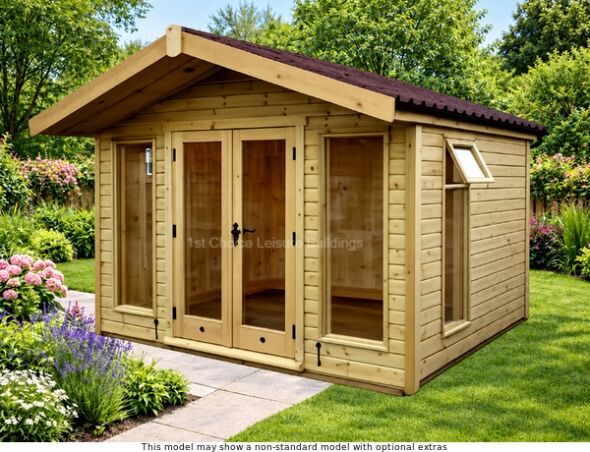
View More Summerhouse Images
Click on images below to see larger versions of summerhouses
l Click on images below to see larger versions of summerhouses
Click on images below to see larger versions of summerhouses
Click on images below to see larger versions of sumerhouse shed combos
Click on images below to see larger versions of combination garden rooms with shed
We recommend OPTIONAL Demidekk Ultimate log cabin paint range which can be colour matched to suit. See examples in
our photo gallery. Please note that all colour shown are indicative only and will vary depending upon the light on the day the photo was taken. Additionally all screens will display the image differently. If exact colour is essential then please order a sample pot.
Diamond vs Platinum vs Royal Summer Houses
Our Diamond, Platinum and Royal ranges offer different levels of specification depending on how you want to use your garden building. Diamond is an excellent choice for a traditional or contemporary summerhouse with plenty of flexibility and value; Platinum steps up the specification with pressure-treated construction and insulation options. At the same time, Royal provides a fully insulated garden room designed for customers wanting a more substantial year-round space.
| Feature | Diamond | Platinum | Royal |
| Best for | Relaxing, entertaining, hobbies and seasonal garden use | Regular leisure, hobbies, home working and extended-season use | Year-round home office, studio, hobby room and premium garden-room use |
| Price position | £ – Best value | ££ – Higher specification | £££ – Premium specification |
| Construction | Quality timber summerhouse construction with solid timber floor and roof | Higher-specification pressure-treated timber construction | Substantial garden-room construction designed around insulation and regular use |
| Insulation | Not the main focus of the range | Full insulation options available; selected models fully insulated | Fully insulated |
| Bespoke flexibility | Excellent choice of sizes, styles and bespoke options | Extensive configuration and specification options | Premium specification with design choices depending on model |
| Styles | Traditional, Georgian, contemporary and corner designs | Apex, pent, contemporary, traditional and corner designs | Contemporary premium garden-room designs |
| Installation | Professional installation or assembly on applicable models | Professional assembly included on applicable models | Professional assembly included on applicable models |
| Why choose it? | You want an attractive, flexible summerhouse without paying for year-round specifications you may not need | You want a stronger specification and the option of insulation for more regular use | You want a fully insulated premium garden room for frequent or year-round use |
Specifications and available options vary between individual models. Always check the specifications of your chosen summerhouse before ordering.
Why Choose a Diamond Summer House?
The Diamond range is an excellent starting point if you want a quality timber summerhouse primarily for relaxing, entertaining, hobbies or enjoying your garden. It offers traditional and contemporary designs, a broad choice of sizes and plenty of bespoke flexibility without requiring you to pay for a fully insulated specification.
Reasons to Choose Diamond
- You want excellent value for money.
- Your main priority is a comfortable garden retreat.
- You mainly expect to use the building during spring, summer and milder weather.
- You want plenty of choice over sizes and styles.
- You need bespoke options to suit your garden.
- You want traditional, Georgian, contemporary or corner designs.
Why Might Diamond Be Right for You?
Diamond could be right for you if you primarily want a proper summerhouse rather than a year-round garden room. If your plans involve summer entertaining, reading, relaxing, hobbies, or simply enjoying the garden, Diamond can provide the space and appearance you want without paying for insulation and construction features you may not need.
Why Choose a Platinum Summer House?
The Platinum range bridges the gap between a traditional summerhouse and a fully insulated garden room. Pressure-treated construction, larger building options and professional insulation upgrades make Platinum particularly attractive if you expect to use your summerhouse more regularly or for longer periods of the year.
Reasons to Choose Platinum
- You want a higher construction specification.
- You prefer pressure-treated timber construction.
- You want the option of full insulation.
- You may use the building as a home office, studio or hobby room.
- You expect to spend longer periods inside your summerhouse.
- You need a larger or more individually configured building.
Why Might Platinum Be Right for You?
Platinum could be right for you if you want more than a conventional summerhouse but do not necessarily require a premium fully insulated Royal garden room. It provides a useful middle ground, allowing you to invest in insulation and additional specification where those features will genuinely improve how you use the building.
Why Choose a Royal Summer House or Garden Room?
The Royal range is aimed at customers looking for a premium fully insulated garden building. Rather than being primarily a seasonal summerhouse, Royal is better suited to frequent use as a home office, studio, hobby room, relaxation space or additional room in the garden.
Reasons to Choose Royal
- You want a fully insulated garden building.
- You expect to use the room throughout the year.
- You want a premium garden-room specification.
- You plan to work from the building regularly.
- You want a studio, hobby room or comfortable garden retreat.
- Comfort and year-round usability are more important than achieving the lowest initial price.
Why Might Royal Be Right for You?
Royal could be right for you if the building will function as a genuine additional room rather than primarily as a summer retreat. If you expect to work, study, pursue hobbies, or spend substantial time indoors throughout the year, investing in a fully insulated specification is much easier to justify.
Which Summer House Range Should I Choose?
| Your Priority | Recommended Starting Point |
| Best value summerhouse | Diamond |
| Relaxing and entertaining during warmer months | Diamond |
| Traditional or Georgian appearance | Diamond |
| Bespoke summerhouse at a competitive price | Diamond |
| Higher-specification summerhouse | Platinum |
| Pressure-treated construction | Platinum |
| Insulation option | Platinum |
| Extended-season hobby or office use | Platinum |
| Fully insulated as standard | Royal |
| Regular year-round home office | Royal |
| Premium additional garden room | Royal |
Diamond, Platinum or Royal: The Simple Choice
Choose Diamond if you want an attractive, flexible and good-value summerhouse primarily for leisure, hobbies and enjoying your garden.
Choose Platinum if you want to step up the construction specification, require pressure-treated timber or want insulation options for more regular and extended-season use.
Choose Royal if your priority is a premium fully insulated building that will function more like an additional room and be used regularly throughout the year.
The most expensive range is not automatically the right one. The best value comes from choosing the specification that matches how you will actually use the building. There is little benefit in paying for year-round performance if you want somewhere attractive to enjoy summer afternoons. At the same time, regular home working can make investment in a fully insulated building worthwhile.
See our complete range of summer houses to compare the available Diamond, Platinum and Royal buildings.
Why Trust 1st Choice Leisure Buildings?
Choosing a garden building is an investment, so it's important to buy from a company you can rely on. At 1st Choice Leisure Buildings, we've been helping customers find the right garden sheds, summerhouses, log cabins, garden offices and workshops
since 1979 when
Robin Antill opened the doors. As a
family-run business, we believe in offering honest advice rather than a hard sell. We take the time to understand what you need and help you choose a building that suits your garden, your budget and the way you plan to use it.
Our approach is reflected in our
4.9 Trustpilot rating, where customers regularly mention our friendly, helpful service. We only work with manufacturers we trust, selecting buildings that offer good quality, durability and value for money. Most are made from
FSC®-certified timber and built to cope with the British weather. If you'd rather see a building before you buy, you're welcome to visit one of the
UK's largest garden building display sites. 1st Choice – Known For Quality – Loved For Design - Since 1979
Being able to compare different models and talk things through with our experienced team helps many customers make the right decision. Since 1979, we've supplied over 50,000 buildings across the UK, building our reputation on quality products, straightforward advice and customer service you can depend on. We are always available to meet your needs or requirements so
contact us NOW if you would like help or advice.
We live quite far away; is it really worth visiting our show rooms? Absolutely!
We strongly urge anyone looking for a new building – whether it's a new garden shed, summerhouse, workshop, garage, or a full garden room – to
visit and inspect the quality in person before committing to any purchase.
Seeing the craftsmanship, materials and finishes for yourself is the best way to make a confident and informed decision.
Whilst we cannot display everything we offer, we have carefully selected around 80 different buildings that allow us to demonstrate almost every feature, design option, and construction detail in one form or another.
This allows you to compare styles, sizes and specifications, ask any questions you may have, and find the building that best suits your needs.
So, yes, it is absolutely worth visiting.
Click here to see what buildings on display. If you are unsure then
why not walk through our site virtually using our walk through tour below (or
click here to open in a new full screen window). More Information In Our Help Articles and Blogs
If you are still deciding which summer house is right for your garden, our help articles cover many of the questions customers ask before and after buying. From choosing the right style and understanding costs to planning permission, foundations, insulation, heating and condensation, these practical guides can help you make a more informed decision. You will also find advice on looking after your building and ideas for making your new summer house comfortable, attractive, and suitable for how you intend to use it.
How To Choose a Summerhouse Shed
Choosing a summerhouse shed involves thinking about much more than its appearance. The right building should provide enough space for how you intend to use it while also fitting comfortably into your garden. You may need to consider its size, position, construction, windows, doors and overall specification. Our guide explains key points to consider before you decide and can help you narrow down the many styles and options available. Read our guide to choosing a summerhouse shed.
Best Summerhouse Guide
With so many sizes, styles and specifications available, deciding which summerhouse is best for your needs can initially seem difficult. Your ideal choice will depend on your garden, available space, budget and what you want to do inside the building. Whether you are creating a space to relax, entertain, enjoy hobbies, or work from home, our summerhouse guide explains the key considerations that can help you compare options and choose a building that suits you and your garden. Read our best summerhouse guide.
How Much Does a Summer House Cost in the UK?
The cost of a summer house can vary considerably depending on its size, construction, specification and the features you choose. A straightforward garden retreat will naturally have different requirements from a larger insulated building intended for regular use throughout the year. It is also sensible to consider associated costs when planning your budget. Our detailed guide looks at summer house prices in the UK and explains some of the factors that can influence how much you should expect to spend. Find out how much a summer house costs.
Planning Permission Guide
Before installing a summer house, it is important to establish whether your proposed building is likely to require planning permission. Many garden buildings can be installed under permitted development rights, but restrictions and circumstances may apply. Factors such as the building's position, overall dimensions, and intended use can be relevant. Our planning permission guide provides useful information to help you understand the rules and identify when you may need to seek further advice before proceeding with your project. Read our summerhouse planning permission guide.
Heating Your Summerhouse Ideas
A little additional warmth can make your summerhouse considerably more comfortable during cooler weather and help extend the amount of time you can enjoy it throughout the year. The best heating solution depends on the size and construction of your building, whether it is insulated, how often you use it, and whether electricity is available. Our guide explores different ways to heat a summerhouse and highlights practical considerations when creating a warmer, more comfortable garden retreat. Explore ideas for heating your summerhouse.
Are Summer Houses Worth It?
A summer house can provide valuable additional space without changing the main structure of your home, but whether one is worthwhile depends on what you expect from your garden building. For some people, it provides a peaceful place to relax, while others use it as an office, hobby space, entertaining area, or multipurpose garden room. Our guide considers the practical advantages of owning a summer house and the points worth thinking about when deciding whether investing in one is the right choice for your household. Discover whether a summer house is worth it.
How To Build the Foundations and Base
A suitable base is one of the most important preparations when installing a new summer house. The base needs to provide a firm, level and stable surface capable of supporting the building correctly over the long term. Poor preparation can cause problems with doors, windows, and the overall structure once the building is installed. Our foundation guide explains different summerhouse base options and provides useful information to consider when preparing your garden before your new building is delivered and installed. Read our guide to summerhouse bases and foundations.
How To Control Condensation
Condensation and excess moisture can affect garden buildings, particularly during colder or damp periods when differences between internal and external temperatures become greater. Good ventilation, sensible heating, and appropriate building maintenance can all help control moisture levels. Understanding why condensation develops makes it easier to take practical steps to reduce it and protect your summerhouse and its contents. Our guide explains common causes of condensation and offers helpful suggestions for maintaining a drier, more comfortable environment inside your building. Learn how to control condensation in your summerhouse.
How To Insulate Your Summer Building
Insulating a summerhouse can help create a more comfortable internal environment and may be particularly worthwhile if you plan to use the building beyond the warmer summer months. You can incorporate insulation into areas such as the walls, floor, and roof, although the best approach depends on your building's construction. Our insulation guide explains the principles involved, the areas you should consider and why insulation can make such a difference when creating a garden office, hobby room or year-round retreat. Read our guide to insulating a summerhouse.
Colourful Summer House Paint Ideas
The colour you choose for your summerhouse can completely change how the building looks within your garden. Traditional natural shades can help it blend into surrounding planting, while brighter colours can transform the building into an attractive focal point. You can also use contrasting colours on doors, windows and trim to create a more individual appearance. Our summerhouse paint guide explores different colour schemes and inspires you to choose a finish that complements your garden, personal style, and the character of your summer building. Explore colourful summerhouse paint ideas.
Create a relaxing garden retreat, home office, hobby room or entertaining space with a quality wooden summer house from 1st Choice Leisure Buildings.
Our summer houses are available in traditional and contemporary designs, with apex, pent and corner styles, plus painted, bespoke and insulated options. Depending on the model, sizes range from compact summer houses for smaller gardens to substantial buildings up to 28 x 16ft.
We’ve been helping customers choose garden buildings since 1979, and you can see and compare summer houses in person at our large Surrey show site near Guildford and Woking.
Professional assembly or installation is included with many of our summer house ranges throughout England, so you don’t necessarily have to build your new summer house yourself.
Summer houses from £1,520 | Bespoke sizes available | Insulation options | Paint finishes | Professional assembly/installation | Surrey showroom
Summer Houses at a Glance
Platinum Fleet double-glazed and fully insulated garden room.
Prices: From £1,520
Sizes: From compact garden buildings to selected models up to 28 x 16ft
Styles: Traditional, contemporary, apex, pent and corner
Construction: Quality timber construction with wooden floors and roofs on principal ranges
Glass: Toughened glass on applicable ranges
Insulation: Available on selected insulated summer houses
Paint finishes: Available on selected painted summer houses
Bespoke designs: Available on selected ranges
FREE Assembly/installation: Included with many ranges, subject to model and delivery area
Base construction: Available as an additional service
Showroom: Sutton Green, between Guildford and Woking in Surrey
Established: 1979
Use the filters above or browse summer houses by size to compare buildings by dimensions, roof style, cladding, insulation and other important features.
Which Summer House Is Right for You?
The best summer house isn’t necessarily the biggest or most expensive one. It is the building that suits your garden, how often you intend to use it and what you want to do inside. Our summer house buying guide provides further advice if you’re still deciding.
Platinum Odiham double-glazed and fully insulated garden room.
For Relaxing in the Garden
A traditional glazed summer house is ideal if you mainly want somewhere comfortable to sit, read, enjoy the garden or entertain friends during the warmer months.
Look for plenty of natural light, a practical internal layout and doors positioned to make the most of your garden.
For a Home Office
If you expect to work in your summer house regularly, consider an insulated summer house.
Insulated walls, roof and floor, suitable glazing, electricity and heating can make the building significantly more comfortable during colder weather.
For intensive year-round working, also compare our dedicated garden rooms and garden offices.
For a Small Garden
A compact or corner summer house can provide useful additional space without dominating the garden.
Corner summer houses are particularly useful where you want to make better use of an otherwise awkward corner while retaining an attractive view across the garden.
For Entertaining
Choose a larger summer house with generous glazing and wide or double doors if you want space for seating, dining or entertaining.
Think about the space around your furniture as well as the furniture itself. A summer house that looks spacious when empty can feel very different once a table, chairs, sofa or storage has been added.
For Hobbies and Creative Work
A summer house can make an excellent art studio, craft room, music space or hobby room.
Prioritise natural light, usable wall space, electrical requirements and storage when deciding on the layout.
For Leisure and Storage
If you need somewhere to relax but don’t want to lose valuable garden storage, consider a summer house and shed combination.
These buildings provide two functions within one footprint: an attractive leisure area alongside a separate storage section for tools, bikes, garden furniture or equipment.
Compare Summer House Types
Traditional Summer Houses
Diamond Ashington Apex Summer House
Best for: Relaxing, reading and enjoying the garden.
Traditional summer houses normally feature an apex roof, generous glazing and a classic timber appearance. They suit both traditional and contemporary gardens and remain one of the most versatile choices.
Contemporary Summer Houses
Best for: Modern gardens and contemporary homes.
Clean lines, pent roofs and modern glazing give contemporary summer houses a more architectural appearance. They work particularly well alongside modern patios, landscaping and recently renovated homes.
Insulated Summer Houses
Best for: Regular use throughout more of the year.
Insulated summer houses help reduce heat loss and temperature fluctuations. If you’re planning a home office, studio, gym or frequently used hobby room, an insulated building will normally be a better starting point than a basic seasonal summer house.
Corner Summer Houses
Best for: Smaller gardens and unused corners.
A corner summer house can make excellent use of the available garden space while providing an attractive outlook through glazed doors and windows.
Summer House and Shed Combinations
Best for: Gardens requiring leisure space and secure storage.
A summerhouse shed combination can be more efficient than installing a separate summer house and shed, particularly where garden space is limited.
Painted Summer Houses
Best for: Coordinating your building with your house or garden.
Painted summer houses offer factory-applied colour options that can give a timber summer house a more individual appearance while reducing the amount of finishing required after installation.
What Size Summer House Do I Need?
Platinum Winchester Reverse Apex Georgian garden studio.
Start by deciding what will actually go inside the building.
For a simple garden retreat with two chairs and a small table, a compact summer house may be perfectly adequate. You can also browse our small summer houses if garden space is limited.
If you want a sofa, desk, dining table, exercise equipment or several seating areas, allow substantially more room.
Before ordering, mark the proposed dimensions on the ground with string, canes or masking tape. Then place garden furniture or cardboard templates inside the marked area.
This simple exercise gives you a much better impression of the usable space than dimensions on a screen.
When choosing the size, remember to consider: furniture and storage; space for doors to open; circulation around furniture; the position of windows; electrical equipment; future uses for the building; and access around the outside for maintenance.
If your garden allows it, choosing slightly more space than you currently need can make the building considerably more versatile in the future.
Summer House Sizes
Our summer houses are available in a wide choice of dimensions. You can view all summer houses by size or explore some of the most popular dimensions below.
7 x 5ft: A compact retreat for smaller gardens. View 7 x 5 summer houses.
8 x 6ft: Suitable for seating or a small hobby area. View 8 x 6 summer houses.
8 x 8ft: A useful square-format garden room. View 8 x 8 summer houses.
10 x 6ft: A good choice where garden depth is restricted. View 10 x 6 summer houses.
10 x 8ft: A versatile size for leisure or hobbies. View 10 x 8 summer houses.
10 x 10ft: Useful for larger seating arrangements. View 10 x 10 summer houses.
12 x 8ft: A popular multipurpose size. View 12 x 8 summer houses.
12 x 10ft: Generous space for leisure or working. View 12 x 10 summer houses.
12 x 12ft: A spacious square layout. View 12 x 12 summer houses.
14 x 8ft: A practical long-format summer house. View 14 x 8 summer houses.
14 x 10ft: A substantial leisure or hobby room. View 14 x 10 summer houses.
16 x 8ft and larger: Suitable for more ambitious garden-room layouts. View 16 x 8 summer houses.
Selected ranges can be made considerably larger, with some models available up to approximately 28 x 16ft.
Bespoke dimensions are also available on selected summer houses if a standard size doesn’t suit your garden.
Apex or Pent Roof: Which Is Better?
Both roof styles can make an excellent summer house. The choice is primarily about appearance, internal headroom and where the building will sit.
Apex Roof Summer Houses
An apex roof rises to a ridge, normally running along the centre of the building.
It creates the familiar traditional summer-house appearance and provides additional internal height towards the centre.
Choose an apex roof if you prefer a classic garden-building design or want a greater feeling of height inside.
Pent Roof Summer Houses
A pent roof slopes in one direction and gives the building a cleaner, more contemporary appearance.
Pent summer houses work particularly well in modern gardens and can sometimes be useful where the visual height of the building needs to be minimised. See our Twyford pent summer house for an example of a contemporary pent design.
Neither design is automatically better. Choose according to your garden, preferred appearance and the specification of the individual building.
What Makes a Good Quality Summer House?
Platinum Highclere summerhouse
Two summer houses can look similar in photographs while being very different when you inspect them closely.
When comparing buildings, don’t concentrate on price alone. Look at the complete specification. Our guide to choosing the best summer house explains more of the details worth comparing.
Timber and Cladding
Check the species and quality of timber and how the wall boards are constructed.
Many of our principal timber ranges use redwood rather than cheaper whitewood alternatives.
Tongue-and-groove summer houses use interlocking boards to create a more substantial wall than thin overlapping boards commonly found on budget garden buildings.
Framing
The internal framework forms the skeleton of the summer house.
Look at both the dimensions of the framing and how frequently the structural members are positioned. Stronger construction can improve rigidity and long-term durability.
Floor
Check whether a proper timber floor is included.
Also consider the thickness of the floorboards and supporting floor joists, particularly if you intend to install heavy furniture, exercise equipment or storage.
Roof
Look beyond the roof covering.
Check the material underneath it, how the roof is supported, and what covering or upgrade options are available.
Windows and Doors
Windows are an important part of any summer house because they determine how light and inviting the interior feels.
Check the type and thickness of glazing, whether windows open, the construction of the frames and the quality of the doors and hardware.
Toughened glass is supplied as standard on applicable 1st Choice ranges.
Treatment and Paint
Timber needs appropriate protection against the weather.
Depending on the range, treatment and coloured paint finishes may be available. You can compare painted summer houses and pressure-treated summer houses. Always follow the maintenance requirements supplied with your particular building.
Can a Summer House Be Insulated?
Yes. Insulation is available on selected summer houses and can significantly improve comfort when you intend to use the building beyond warm summer days.
Depending on the specification, insulation can be incorporated into the walls, roof and floor.
Suitable glazing can also help reduce heat loss.
An insulated summer house is worth considering for a home office, studio, hobby room, gym or other space that will be occupied regularly. You can also read our guide explaining how to insulate a summer house.
However, insulation doesn’t automatically turn a garden building into residential accommodation. If you intend to sleep in or use a garden building as separate living accommodation, different planning and Building Regulations considerations may apply.
Can I Use a Summer House All Year?
Platinum Kingsclere Summer building.
A summer house can be used throughout much or all of the year if it has been specified appropriately for the intended use.
For occasional winter visits, a good-quality timber building with suitable heating may be sufficient. Our guide to heating a summer house efficiently explains the main options.
If you’re planning to use your greenhouse regularly through the colder months, it’s worth making it a bit more comfortable. Insulation will help keep the warmth in, while choosing the right glazing can make a real difference too. You may also want electricity for lights and equipment, along with some heating on particularly cold days. Good ventilation is just as important, helping to keep condensation and excess moisture under control.
If moisture is a concern, see our advice on preventing condensation in a summer house.
If year-round comfort is your main priority, compare the specifications of an insulated summer house with a purpose-designed insulated garden room before deciding.
Summer House or Garden Room?
The terms are sometimes used interchangeably, but there is usually a practical difference.
A summer house is traditionally a timber garden building designed primarily for leisure and seasonal use. Modern versions can be highly specified and insulated, but many customers still choose them principally as garden retreats.
A garden room is more commonly designed from the outset as a highly insulated space for frequent year-round occupation, such as a home office, studio or entertainment room.
Choose a summer house if your priorities are garden enjoyment, attractive design, versatility and value.
Consider a dedicated garden room or garden office if your overriding requirement is an indoor-like environment for intensive use throughout the year. For a more detailed comparison, read the difference between a summer house and a garden room.
Do Summer Houses Need Planning Permission?
Many domestic summer houses in England can be installed under permitted development rights without making a planning application, but this is not universal.
Whether permission is required depends on factors including the building’s position, height, intended use, the amount of land covered by buildings and the status and location of the property.
Additional restrictions can apply to listed buildings, designated land and other properties where permitted development rights have been removed or restricted.
Rules can also differ elsewhere in the UK.
For that reason, don’t rely solely on a statement that a summer house “doesn’t need planning permission”. Read our detailed summer house planning permission guide and check the current requirements that apply to your property and proposed building before ordering.
If you’re unsure, contact your local planning authority or seek professional planning advice.
You Need a Proper Base
Even an exceptionally well-made summer house will perform badly if it is installed on an inadequate base.
The base needs to be level. Hence, doors, windows and panels align correctly, are firm so the building doesn’t settle unevenly, are adequately supported for the weight and construction of the building, and are appropriately sized for the building ordered.
Suitable solutions can include concrete and other purpose-designed garden-building bases, depending on the size and specification of the building and site conditions.
Don’t assume an existing patio or paving is automatically suitable.
Read our detailed summer house base guide for advice on preparing a suitable foundation.
We can provide a base-building service where available, or advise what needs to be prepared before installation.
Summer House Installation
Installing a summer house correctly is important for its performance and longevity.
Many 1st Choice summer house ranges include professional assembly or installation within the applicable delivery area.
This means you can have your building erected by an experienced installation team rather than spending your weekend trying to decipher panels, roofing materials and fixings.
Exactly what is included varies by product, so check the individual product specification and delivery area before ordering.
The customer is normally responsible for ensuring that the site and base are ready and accessible before the installation team arrives unless separate base construction has been arranged.
If you’re unsure about installation, access or base requirements, contact 1st Choice Leisure Buildings before ordering.
Where Should I Put My Summer House?
Position can make almost as much difference as the building itself.
Before choosing a location, consider sunlight, the view from inside, privacy, access, maintenance space and any services you intend to run to the building.
Sunlight
Think about when you are most likely to use the building.
A position that catches the evening sun might be ideal for relaxing after work, while direct midday sunshine through large areas of glass can make some buildings considerably warmer.
View
Summer houses are designed to help you enjoy your garden, so consider what you’ll actually see when you’re sitting inside.
Privacy
Think about neighbouring properties and sight lines through windows and doors.
Access
There must be suitable access to get the building components from the delivery vehicle to the installation site.
Maintenance
Leave enough room around the building where possible to inspect, clean and maintain the external timber.
Services
If you want electricity, internet, lighting or heating, consider how those services will reach the building before installation.
Bespoke Summer Houses
Sometimes a standard building doesn’t fit.
Your garden might have an unusual shape, you may need doors on a particular elevation, or the ideal size might fall between standard dimensions.
Bespoke options are available on selected 1st Choice summer house ranges.
Depending on the model, you may be able to alter the width and depth, door position, window position, number of windows, roof style, paint colour, internal specification and insulation.
Tell us what you’re trying to achieve, and we can advise whether an existing model can be adapted or whether another range would be more suitable. Contact us about a bespoke summer house.
Painted Summer Houses
A coloured finish can transform the appearance of a summer house and help it coordinate with your home, fencing, decking or landscaping.
Painted summer houses are available on selected ranges, allowing you to choose a finish before the building reaches your garden.
Neutral shades can help a larger building sit quietly within its surroundings, while contrasting colours can turn the summer house into a garden focal point.
Remember that all external timber finishes require maintenance eventually. Follow the care instructions provided with your chosen building to maintain its appearance and protection.
Why Buy Your Summer House from 1st Choice?
Buying a summer house is very different from buying an ordinary piece of garden furniture. You’re purchasing a building that you may expect to use for decades.
That’s why we encourage customers to compare construction rather than choosing from photographs alone.
Helping Customers Since 1979
1st Choice Leisure Buildings has been helping customers choose garden buildings since 1979.
That experience matters because there isn’t one summer house that’s right for everyone. The appropriate recommendation depends on your garden, budget, intended use and expectations.
Our aim is straightforward advice rather than pushing every customer towards the most expensive building.
See Summer Houses Before You Buy
One of the biggest advantages of buying from 1st Choice is the opportunity to inspect garden buildings in person at our extensive Surrey show site.
Photographs cannot easily show differences in timber thickness, framing, floors, doors, glazing and overall rigidity.
Seeing buildings side by side gives you a much better understanding of what you’re paying for.
Professional Installation
Many of our summer house ranges include professional assembly or installation in the applicable areas.
That removes one of the biggest difficulties associated with buying a large timber garden building and helps ensure it is erected correctly.
Bespoke Options
Selected ranges can be adapted to suit particular gardens and requirements rather than forcing you to compromise with an unsuitable standard size.
Real People to Ask
If you’re unsure about sizes, bases, specifications, insulation or delivery, speak to us before ordering.
A short conversation before purchase can prevent an expensive mistake afterwards.
Visit Our Summer House Showroom in Surrey
If you’re deciding between two or three summer houses, seeing our garden buildings in person is one of the best ways to choose.
1st Choice Leisure Buildings
Sutton Green Garden Centre
Whitmoor Lane
Sutton Green
Guildford
Surrey GU4 7QA
The display site is conveniently located between Guildford, Woking and Ripley.
Around 80 different garden buildings are displayed across the wider show site, enabling visitors to compare many construction methods, materials, sizes, styles and specifications in person.
Not every model can be displayed, but the show site allows us to demonstrate the important differences that are difficult to appreciate online.
Summer House Buying Checklist
Buying a summer house isn’t something most people do very often, so it’s worth getting a few things straight before you order. A little bit of measuring and checking beforehand can save a lot of aggravation afterwards.
1. What are you going to use it for? This is the best place to start. Somewhere to sit with a cup of tea is one thing; a hobby room, home office or garden room you’ll use most days is another. Once you know what you want from it, choosing the right building becomes much easier.
2. Have you allowed enough room inside? A summer house can look plenty big enough until you put a table, chairs and a few other bits in it. Think about what’s actually going inside and give yourself a bit of breathing room.
3. Will it fit comfortably in the garden? Measure the garden properly and, if you can, leave some room around the building. You don’t really want it squeezed hard against a fence or wall, especially when it comes to treating the timber or carrying out maintenance later on.
4. Have you got a decent base? This is one we always tell customers not to skimp on. Your summer house needs a solid, flat and level base. Get the base right, and you’re giving the building the best possible start. Our summer house base guide explains the different options.
5. Can we get the building into your garden? It sounds obvious, but it’s easily overlooked. Have a look at gates, alleyways, garages, steps, tight corners and anything else between the road and where the building is going.
6. What are you actually getting for your money? Two summer houses can look very similar in a photograph but be quite different when you look at how they’re made. Check the thickness and type of cladding, the framing, and the construction of the floor and roof. These are the bits that matter once the building is standing in your garden.
7. Have a proper look at the windows. Think about how much light you want inside, whether you need opening windows and what sort of glazing is supplied. If you’re going to spend a lot of time in the building, it’s worth getting this right.
8. Are you planning to use it through the winter? For the odd sunny afternoon, a standard summer house may be all you need. If you want to use it regularly when the weather turns colder, it’s worth looking at insulation. Have a look at our insulated summer houses to see the difference.
9. Have you checked the planning rules? Most garden summer houses can be put up without planning permission, but that doesn’t mean every building on every property is automatically covered. It’s worth checking before you buy. Our summer house planning permission guide will point you in the right direction.
10. Do you know what happens on delivery day? Check exactly what’s included with delivery and installation, what you need to have ready beforehand and whether there’s anything the installers will need from you. It makes life easier for everybody on the day.
And if you’re not sure about something, give us a shout before you order. We’ve been around garden buildings a long time and would much rather answer a question beforehand than see somebody end up with the wrong building afterwards.
Frequently Asked Questions About Summer Houses
How Much Does a Summer House Cost?
Prices vary according to size, construction, design and specification.
The summer houses currently offered by 1st Choice start from approximately £1,520, with larger, insulated and more highly specified buildings costing more.
Compare the complete specification rather than the headline price alone. A cheaper summer house may exclude features such as installation, a substantial timber floor, tougher glazing or other elements included with a higher-quality building.
Always check the current individual product price before ordering from our summer house range.
What Is a Summer House?
A summer house is a freestanding garden building designed primarily to provide comfortable additional leisure space.
Unlike a conventional garden shed, which is principally intended for storage, summer houses normally feature larger areas of glazing and a more decorative design.
They can be used for relaxing, entertaining, hobbies, creative work and, with an appropriate specification, home working. See our wider summer house range and guides for more information.
What Is the Best Size Summer House?
There isn’t one best size.
A compact building may be ideal for two people relaxing in a smaller garden, while a home office, entertaining room or multi-purpose space will usually require more floor area.
Mark the dimensions out in your garden and plan the furniture before ordering, then compare available summer house sizes.
Are Summer Houses Waterproof?
A correctly constructed and maintained summer house is designed to protect the interior from normal British weather.
Long-term weather resistance depends on the quality of the building, roof covering, installation, base and ongoing maintenance.
Inspect the roof and external finish periodically and deal with damage promptly.
How Long Does a Summer House Last?
A good-quality timber summer house can last for decades when correctly installed and maintained.
Its lifespan depends heavily on construction quality, the base, exposure to weather, timber protection, roof maintenance and how quickly any defects or water ingress are addressed.
Do Summer Houses Need Maintenance?
Yes. Timber is a natural material and requires appropriate protection.
Depending on the building and finish, maintenance can include treating or repainting external timber, checking roofing materials, keeping gutters clear where fitted and inspecting doors, windows and seals.
Always follow the maintenance instructions supplied with your particular model.
Can You Use a Summer House as an Office?
Yes.
For occasional home working, a conventional summer house may be adequate.
For regular year-round work, consider insulation, suitable glazing, heating, ventilation, electricity and internet connectivity. A dedicated garden office or insulated garden room may also be worth comparing.
Can You Sleep in a Summer House?
Occasionally, using a garden building and using it as separate residential or sleeping accommodation are not necessarily treated the same way under planning and Building Regulations.
If you intend to create sleeping accommodation or an independent living space, obtain appropriate advice before buying the building. See our summer house planning permission guide for further information.
Can I Put Electricity in a Summer House?
Yes, electricity can be supplied to a summer house.
Electrical installation should be designed and carried out by an appropriately qualified person in accordance with applicable regulations.
Plan your sockets, lighting, heating and internet requirements before installation where possible.
Do I Need a Concrete Base?
Not necessarily.
Concrete can provide an excellent base, particularly for larger buildings, but other properly designed base systems may also be suitable.
The important requirements are that the base is firm, level, stable and appropriate for the building being installed.
Read our guide to building a summer house base or ask us if you’re unsure what base your chosen building requires.
Does the Base Need to Be Perfectly Level?
The base needs to be sufficiently level and stable for the building to be installed correctly.
An uneven base can cause panels to move out of alignment and doors or windows to operate incorrectly.
Correcting the base before installation is much easier than trying to correct the building afterwards.
Can You Build a Summer House Yourself?
Some summer houses can be self-assembled by competent DIYers, but larger buildings can require considerable time, tools and assistance.
Correctly positioning the panels, fixing the roof and weatherproofing the structure are particularly important.
Many of our summer house ranges include professional assembly or installation, which removes this work from the customer.
Are Flat-Pack Summer Houses Available?
Yes, some garden buildings are supplied for self-assembly.
If you’re comparing a flat-pack price with an installed summer house, make sure you compare like with like and account for the construction specification, delivery, assembly time and any additional materials required.
What Is the Difference Between a Summer House and a Shed?
The main difference is intended use.
A shed is primarily designed for storage or practical work.
A summer house is primarily designed as a comfortable garden leisure space and therefore normally has more glazing and a more decorative appearance.
Summer house and shed combination buildings provide both functions within one structure.
What Is the Difference Between a Summer House and a Garden Room?
A traditional summer house generally focuses on leisure and seasonal garden use, whereas a garden room is more commonly designed for regular year-round occupation.
The differences can include wall construction, insulation, glazing and overall thermal performance.
Read our full guide explaining the difference between a summer house and a garden room.
Is an Insulated Summer House Worth It?
It can be if you intend to spend significant time in the building during colder weather.
Insulation can reduce heat loss and make temperature control easier.
For a simple retreat used predominantly on warm days, you may decide insulation isn’t necessary. For a frequently used office, studio, gym or hobby room, it is much easier to justify. Compare our insulated summer house range for suitable options.
Can a Summer House Add Value to a Property?
A well-designed garden building can make a property more attractive to some buyers by providing useful additional space. Still, there is no guaranteed amount by which a summer house will increase a property’s sale price.
Choose a building primarily because it improves the usefulness and enjoyment of your home rather than relying on a predicted financial return. Our guide asking whether summer houses are worth it covers the wider benefits and considerations.
Which Direction Should a Summer House Face?
There is no universally correct direction.
It depends on when you want sunlight, your garden layout, neighbouring properties and the view you want from inside.
Observe the movement of the sun through your garden before choosing the final position.
How Close Can a Summer House Be to a Boundary?
The position of a garden building relative to a boundary can affect which planning and Building Regulations rules apply, particularly in relation to height and construction.
Check the rules that apply to your specific proposed building and property rather than relying on a general distance quoted online. See our summer house planning permission guide for further information.
Do You Offer Bespoke Summer Houses?
Yes, bespoke sizes and other customisation options are available on selected 1st Choice summer house ranges.
Depending on the model, this can include changes to dimensions, doors, windows, paint finishes and other specifications.
Contact us with your required dimensions and intended use for advice.
Do You Install Summer Houses?
Professional assembly or installation is included with many of our summer house ranges within the applicable delivery areas.
Check the individual product details because the service and geographical coverage can vary between ranges.
Can I See Your Summer Houses Before Buying?
Yes.
You can visit our large garden-building display site at Sutton Green Garden Centre, Whitmoor Lane, Sutton Green, Guildford, Surrey GU4 7QA, between Guildford and Woking.
The wider show site has around 80 garden buildings on display, allowing you to inspect different construction methods, styles and specifications before making a decision.
Need Help Choosing Your Summer House?
There are a lot of options, and you don’t need to work everything out yourself.
Tell us the size of your available space, what you want to use the summer house for, whether you want year-round use, your preferred style and your approximate budget.
We’ll help you identify the ranges and specifications worth considering. You can also read our summer house buying guide for additional advice.
You can visit our Surrey display site to compare garden buildings in person before you buy, or contact 1st Choice Leisure Buildings for advice.
1st Choice Leisure Buildings — helping customers choose garden buildings since 1979.