Choosing a 7×3 Shed
A 7×3 shed is a practical choice when you need useful garden storage but only have a narrow strip of space available. I’m Robin Antill, founder of 1st Choice Leisure Buildings, and sheds are where my working life in garden buildings began in 1979. After more than 45 years in the trade, I’ve learnt that narrow sheds need particularly careful planning because every inch of floor and wall space matters.
A nominal 7ft x 3ft footprint can work well alongside a house, fence, garage or in a narrow side passage where a conventional deeper shed would take up too much room. Before ordering, think about what you actually need to store, measure the largest items and check the complete space available rather than relying solely on the nominal shed size.
Is a 3×7 Shed the Same as a 7×3 Shed?
You may see a 7×3 shed described as a 3×7 shed or 7ft x 3ft shed. These descriptions normally refer to the same general footprint with the dimensions reversed, but always check which measurement represents the frontage and which represents the depth. This is particularly important with a narrow shed because door position and orientation can make a considerable difference to how practical the building is.
Shoreham Narrow 7×3 Shed
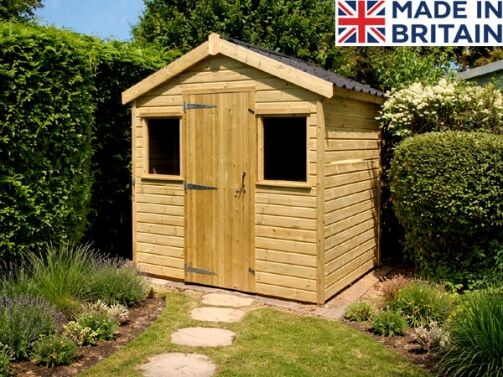
If you specifically want a traditional timber 7×3 shed, the Shoreham Narrow Shed is the product I would look at first on this page. Its standard sizes include 4×3, 5×3, 6×3, 7×3, 8×3, 9×3, 10×3, 11×3 and 12×3, so 7ft x 3ft is a genuine standard size rather than simply a building with approximately similar dimensions.
The Shoreham has been designed for narrow spaces alongside houses and in other restricted parts of the garden. It currently includes free fitting and offers a colour paint finish option. Its constant nominal 3ft width means you can choose the length that best suits your available space and storage requirements.
Allow Enough Space for the Shoreham Roof
One measurement I wouldn’t overlook is the total space the building needs rather than just the nominal 3ft shed width. Although the Shoreham is designed for narrow passages, its roof projects beyond the walls, and the current specification advises allowing a gap of about 3 ft 4 in (101cm). Measure the full available width before ordering, rather than assuming a passage measuring exactly 3ft wide will be sufficient.
Shoreham Construction
The Shoreham uses 16mm tongue and groove shiplap cladding with 50 x 45mm nominal 2×2 framing. It also has a tongue-and-groove timber roof and tongue-and-groove timber floor, supported on pressure-impregnated joists. These are the sorts of construction details I have always encouraged customers to look at rather than choosing a shed simply from a photograph or headline price.
Having manufactured timber sheds myself, I know that the parts you don’t immediately notice can be just as important as the appearance. Framing, floor and roof construction all contribute to how substantial a shed feels and how well it performs in everyday use.
Other Narrow Storage Products on This Page
The current page also displays the Tarrickdale Shed, Silverdale Slimline, Skelmersdale Shed, Avondale Bike Shed and Deepdale Workshop. These are galvanised-steel buildings rather than conventional timber sheds, and their dimensions vary, so I would compare them according to what you actually need to store rather than treating all of them as direct equivalents to a 7ft x 3ft Shoreham.
Tarrickdale – A Narrow Steel Alternative
The Tarrickdale Shed measures approximately 87 x 38 inches, or around 220 x 95cm, making it one of the closest steel alternatives on this page to somebody searching for a 7ft x 3ft shed. Its current specification includes 0.9mm galvanised-steel construction, a choice of colours and an assembly service, and it is designed to bolt to a suitable base.
If you like the proportions of a 7×3 building but prefer galvanised steel to traditional timber, I would compare the Tarrickdale directly with the Shoreham while remembering that their construction and precise dimensions are different.
Silverdale Slimline
The Silverdale Slimline is another narrow steel storage product displayed on this page. Its published footprint is approximately 42 x 88 inches, or 106 x 229cm. Its proportions make it particularly relevant where you want a long, relatively shallow building against a wall or fence.
The current specification shows 0.9mm galvanised-steel construction, an assembly service, a choice of colours and a design intended to bolt to the base. Check the precise orientation carefully when planning its position because the published dimensions are presented differently from the usual 7×3 shed description.
Skelmersdale Shed
The Skelmersdale is a more compact steel storage option, measuring approximately 61 x 37 inches. It is therefore considerably shorter than a genuine 7×3 shed. Still, it may suit you better if your available space is particularly restricted and you don’t actually need the full seven-foot length.
Its current specification includes 0.9mm galvanised-steel construction, a choice of colours, an assembly service and a design that bolts to the base.
Avondale Bike Shed
The Avondale Bike Shed is also displayed on this page but serves a more specialised purpose. Its published dimensions are approximately 81 x 41 inches, making it slightly different from a strict 7ft x 3ft footprint.
If bicycle storage is your main requirement, consider the Avondale separately from the general-purpose Shoreham, Tarrickdale, Silverdale and Skelmersdale. Its current specification includes 0.9mm galvanised-steel construction, an assembly service, colour choices and a design that bolts to the base.
Deepdale Workshop
The Deepdale Workshop is the largest product displayed on the current page and should not be regarded as a direct 3×7 shed alternative. Its published sizes start at approximately 89 x 88 inches and extend considerably longer, so it requires substantially more garden space.
The current specification includes heavier 1.2mm galvanised-steel construction, an assembly service, colour choices and a steel floor base. I would only consider the Deepdale from this page if you have more space available and your storage requirements have grown beyond what a narrow 7×3 building can realistically provide.
Why My Experience With Sheds Matters
Customers should know who is behind the advice they are reading. I left school at 15 and started my own garden building business in 1979, trading as Marina Sheds. I was hands-on from the beginning, manufacturing and selling timber sheds, so I learnt about garden buildings by actually working with timber and dealing directly with customers rather than simply reading specifications in a catalogue.
That practical manufacturing background still influences how I judge a shed today. An attractive finish naturally catches your eye, but I also look at the construction, floor, roof, doors, access and whether the building genuinely suits the job it is being bought to do.
I sold Marina Sheds in 1990. Unfortunately, I didn’t receive all the money I was due from the sale. It was a difficult business lesson, but it certainly didn’t end my involvement with garden buildings.
In 1992 we expanded beyond sheds and added summerhouses, garages, garden rooms and log cabins. Marina Sheds no longer properly described the wider business, so this change in direction also meant a change of name, and we became Titan Garden Buildings.
My son Craig joined me in 1992 after studying carpentry at Guildford College from 1990. His carpentry training brought additional practical woodworking and timber-construction knowledge into a business already built around manufacturing and selling garden buildings.
We sold Titan Garden Buildings in 1998 and, in 2000, Craig and I decided to take a different approach. Rather than manufacturing everything ourselves and naturally being tied to our own products, we wanted to use our experience to select quality buildings from established manufacturers. That decision led us to form 1st Choice Leisure Buildings.
Craig now runs the day-to-day business, and I continue to support him and the team as required. I’ve been involved with sheds and garden buildings since 1979. That experience matters because I’ve seen the industry from both sides: first manufacturing and selling garden buildings ourselves and later comparing products from different manufacturers for our customers.
What More Than 45 Years Has Taught Me About Narrow Sheds
More than 45 years around sheds has taught me that a restricted footprint makes good planning more important, not less. With a 7×3 shed, a badly positioned door or excessively deep shelving can waste a surprising amount of usable space. I would choose the layout around what you actually need to store rather than buying purely on headline dimensions or price.
Timber or Steel for a 7×3 Shed?
The products currently displayed give you both approaches. The Shoreham Narrow Shed is the obvious timber choice if you specifically want a standard 7ft x 3ft size. At the same time, the Tarrickdale, Silverdale, Skelmersdale, Avondale and Deepdale provide galvanised-steel alternatives for different storage requirements.
I wouldn’t automatically say timber or steel is better because they suit different priorities. If you prefer the appearance and feel of a traditional timber garden shed, I suggest starting with the Shoreham. If galvanised-steel construction appeals to you, compare the exact dimensions and intended use of the steel models rather than choosing on appearance alone.
Making the Most of a 7×3 Shed
A 7ft x 3ft shed can work well for hand tools, gardening equipment, pots, folding furniture and other relatively narrow items. Measure the largest items you intend to store before ordering, and check the door opening and available floor area.
Wall storage is particularly valuable in a narrow shed. Hooks and shallow shelves can keep smaller items organised while preserving a useful walkway. With only around three feet of nominal depth, I would avoid shelving that projects too far into the building.
Fitting, Assembly and the Base
The Shoreham Narrow Shed currently shows free fitting, while the steel products displayed offer an assembly service. Whichever type you choose, you still need suitable access and an appropriate base. Several steel products are designed to bolt to the base, so correct preparation is essential.
If you need help preparing the site, take a look at our garden building base and additional services. Getting the base right before the building arrives is considerably easier than trying to correct problems afterwards.
Colour Options
The Shoreham Narrow Shed currently offers a colour paint finish option, while the steel storage products displayed provide colour choices. A narrow building is often positioned quite close to a house, fence or boundary, so choosing a finish that works with its surroundings can make a noticeable difference.
Colours shown online can vary because of lighting, photography and different screens. If a precise shade is particularly important, check the available colour information before making your final decision.
See Sheds Before You Buy
I have encouraged customers to inspect sheds before buying for many years. Photographs can show style and colour, but they cannot completely tell you how substantial a floor feels, how a door operates or what the timber and framing are like when you see them close up.
You are welcome to visit our Surrey garden building display site at Sutton Green, near Guildford and Woking. We can’t display every model in every possible size, but seeing representative sheds allows you to compare construction and finishes before making your decision.
Take your time, look closely and ask questions. We don’t believe in high-pressure selling. I started my first shed business in 1979, and I still believe that seeing what you’re buying and understanding the specification are two of the best ways to make an informed decision.
Choosing the Right 7×3 Shed
If you specifically want a traditional timber 7×3 shed, I would begin with the Shoreham Narrow Shed because 7ft x 3ft is one of its standard published sizes. If you prefer steel construction, the Tarrickdale and Silverdale are the closest narrow alternatives among the products currently displayed, while the Skelmersdale gives you a smaller option.
If bicycle storage is your priority, consider the Avondale Bike Shed separately. If you have substantially more room and need a larger steel building, the Deepdale Workshop is also displayed here, although I would not regard it as a direct 7×3 alternative.
The best shed isn’t automatically the cheapest one or the building with the longest specification. It is the one whose dimensions, door arrangement, construction and intended use genuinely suit your available space and what you need to store.
My Advice Before You Order
Mark out approximately 7ft x 3ft in your garden and check how that narrow footprint feels in the actual position. Measure the items you intend to store, check the door opening and confirm the precise overall dimensions of your chosen product before preparing the base. If you are considering the Shoreham, remember that the roof overhang means you need approximately 3ft 4in of available width rather than an exact 3ft gap.
If you’re unsure which 3×7 shed is right for you, please contact us. Tell Craig, me or one of the team what you need to store, how much space you have and where the building will stand. We’ll help you compare the actual products rather than simply pointing you towards the cheapest or most expensive option.
Robin Antill
Founder, 1st Choice Leisure Buildings


 From £709
